
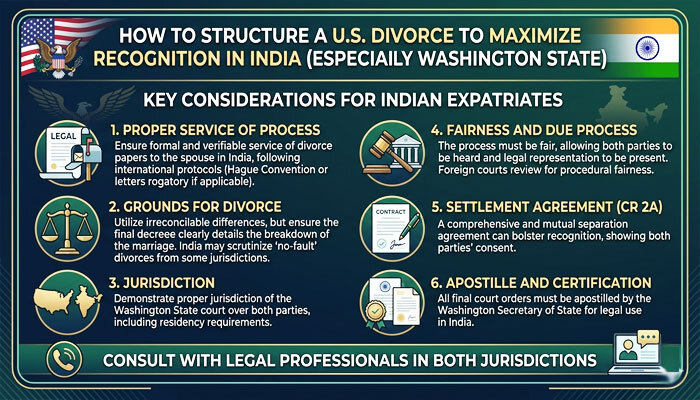
International families increasingly live between legal systems. For many Indian-origin spouses working in the United States particularly in Washington’s technology sector the most overlooked risk in divorce is this:
A divorce valid in the United States may not be recognized in India.
Without proper planning, a person can become legally divorced in Washington State while still considered married under Indian law creating what courts and scholars often call a “limping marriage.”
This article explains why recognition problems occur and, more importantly, how a Washington divorce can be structured strategically to improve enforceability in India.
The Core Problem: U.S. Divorce vs. Recognition in India
Indian courts do not automatically recognize foreign divorce decrees.
Recognition is governed primarily by Section 13 of the Code of Civil Procedure (CPC), interpreted through landmark Indian Supreme Court precedent including Y. Narasimha Rao v. Y. Venkata Lakshmi.
Under Section 13 CPC, a foreign judgment is enforceable in India only if certain conditions are satisfied, including:
- The foreign court had proper jurisdiction
- The decision was on the merits
- Both parties had notice and opportunity to participate
- The judgment is not contrary to Indian matrimonial law principles
This creates tension with U.S. divorce systems especially no-fault divorce jurisdictions like Washington State.
The “Limping Marriage” Problem
A limping marriage occurs when:
- The parties are legally divorced in the United States, but
- India continues to treat them as legally married.
This situation can cause serious consequences:
- Inability to remarry safely in India
- Criminal complaints (bigamy allegations)
- Property or inheritance disputes
- Child custody complications
- Immigration or OCI status concerns
Many professionals discover the problem years later often when attempting remarriage or resolving family property issues in India.
Why “Irretrievable Breakdown” Alone Often Fails in India
Washington State follows a no-fault divorce model.
The court only needs to find that the marriage is irretrievably broken.
However, Indian matrimonial statutes generally recognize divorce on specific statutory grounds, such as:
- Cruelty
- Desertion
- Adultery
- Conversion
- Mental disorder
Indian courts have repeatedly held that irretrievable breakdown alone while accepted in the U.S. is usually insufficient for recognition unless supported by facts corresponding to recognized grounds under Indian law.
Important:
This does not mean Washington law changes.
Instead, it means the case must be litigated and documented intelligently.
Strategic Planning: Structuring a Washington Divorce for Indian Recognition
Cross-border divorce requires litigation strategy from the beginning not after the decree is entered.
Below are key practice considerations.
1. Establish Clear Jurisdictional Findings
Indian courts closely examine whether the U.S. court properly exercised jurisdiction.
Helpful factors include:
- Genuine residence or domicile in Washington
- Length of stay in the U.S.
- Employment ties
- Children’s residence
- Submission to jurisdiction by both spouses
Whenever possible, the decree should clearly reflect why the Washington court had authority over the marriage.
2. Avoid Ex Parte or Default Judgments
One of the most common reasons Indian courts refuse recognition is an ex parte divorce.
If one spouse:
- never appeared,
- did not meaningfully participate, or
- claims improper notice,
Indian courts may conclude the decree violates natural justice.
Best practice:
- Ensure documented service compliant with international standards
- Encourage participation where feasible
- Maintain proof of communication and notice
Participation even limited participation greatly strengthens recognition prospects.
3. Ensure the Case Is Decided “On the Merits”
Indian courts distinguish between:
❌ Procedural divorce
✔ Substantive adjudication
A well-structured Washington divorce should show:
- allegations were presented,
- evidence existed,
- findings were made,
- and the court evaluated the marital relationship.
Detailed pleadings and findings matter.
4. Document Proper Service and Opportunity to Be Heard
Maintain records showing:
- formal service documents
- acknowledgments of receipt
- attorney appearances
- hearing participation
- settlement negotiations or mediation involvement
Recognition often turns on procedural fairness, not just outcome.
The Most Important Step: Building a Record That Aligns With “Mental Cruelty” Under Indian Law
This is where experienced cross-border strategy becomes critical.
Washington remains a no-fault state.
We are not converting the case into a fault divorce.
Instead, counsel builds a factual record demonstrating conduct that Indian courts would recognize as mental cruelty.
Indian jurisprudence recognizes that cruelty does not require physical violence or extreme abuse.
Courts increasingly acknowledge modern marital realities.
Conduct That May Constitute Mental Cruelty
Examples that often translate across jurisdictions include:
- Persistent emotional or verbal abuse
- False accusations harming reputation or career
- Withdrawal from marital obligations
- Refusal to cohabit without justification
- Controlling or manipulative behavior
- Financial pressure, coercion, or economic domination
- Public humiliation or harassment
- Conduct making continuation of marriage unreasonable
These facts can be documented through:
- declarations and affidavits
- pleadings
- mediation statements
- parenting plan disputes
- communication records
- court findings incorporated into final orders
The objective is simple:
Create a Washington State record that an Indian court can understand using Indian legal categories.
What This Does Not Mean
This strategy does not:
- change Washington’s no-fault framework
- require proving fault to obtain divorce
- escalate conflict unnecessarily
Instead, it ensures the legal narrative translates internationally.
The divorce remains a Washington divorce just one drafted with global consequences in mind.
Why Early Strategy Matters
Recognition problems are rarely fixable after the decree.
Once a poorly structured divorce is entered:
- reopening proceedings can be costly,
- parallel litigation in India may become necessary,
- and years of uncertainty can follow.
For international professionals, proactive planning is significantly less expensive than corrective litigation later.
Cross-Border Divorce Strategy: Planning Ahead
U.S.–India family law matters sit at the intersection of two very different legal systems.
A carefully structured Washington divorce can:
- reduce recognition disputes in India,
- prevent limping marriage risks,
- protect remarriage rights,
- and minimize future litigation across jurisdictions.
If your marriage involves ties to India, divorce strategy should begin before filing not after judgment.
Thoughtful planning today can prevent complex international legal problems tomorrow. Our firm regularly advises clients on cross-border divorce strategy, including cases involving Indian nationals, NRI professionals, and technology-sector families navigating both U.S. and Indian legal systems.
FAQ
No. Indian courts review foreign divorce decrees under Section 13 of the Civil Procedure Code. Recognition depends on jurisdiction, fairness, participation of both spouses, and whether the decision aligns with Indian matrimonial law principles.
A limping marriage occurs when spouses are legally divorced in the United States but still considered legally married in India because the foreign decree is not recognized.
Indian courts may refuse recognition when divorces are granted ex parte, based solely on irretrievable breakdown, or entered without proper participation or findings consistent with Indian divorce grounds.
No. Washington remains a no-fault divorce state. However, documenting marital conduct that aligns with mental cruelty under Indian law can improve recognition outcomes abroad.
Mental cruelty can include emotional abuse, false accusations, refusal to cohabit, controlling behavior, financial coercion, or conduct making continuation of the marriage unreasonable.
Sometimes, but corrective litigation is complex and expensive. Strategic planning during the Washington divorce process is the most effective way to avoid recognition problems in India.